
You look like you are holding it together in front of people, but inside it feels like you are constantly bracing for something bad to happen. You overthink interactions, have no energy by the time you get home, or feel waves of shame or panic that don’t always match what’s happening around you. In a busy place like Charlotte, where everyone else seems to be doing just fine, it can be easy to assume this is being too sensitive or not trying hard enough.
This is not a reflection of who you are. It is what happens when your body and mind have spent years in survival mode. Complex PTSD (CPTSD) is one way to understand this pattern. It is what can develop when hard things happen over and over, especially in childhood, and your nervous system never really gets a chance to stand down.
What is Complex PTSD?
Most people have heard of PTSD in connection with a single terrible event, like a car wreck, an assault, or military combat. Complex PTSD is different. It tends to grow out of repeated, long term experiences where you felt unsafe, powerless, or alone, especially when those experiences happened in your family or close relationships.
These might include:
- Growing up with constant criticism, yelling, or put downs
- Emotional neglect, no one comforting you, listening, or caring how you felt
- Physical, emotional, or sexual abuse
- Living with a caregiver who had untreated addiction or serious mental illness
- Witnessing domestic violence or chaos in the home
When these kinds of experiences go on for years, they do not just create bad memories. They shape how you see yourself, other people, and the world. You might notice:
- Emotions that feel intense, unpredictable, or arrive without an obvious trigger
- A harsh inner voice that is quick to criticize or insist you are not enough
- Difficulty trusting others, or finding yourself moving between closeness and distance in relationships
- A persistent, quiet sense of shame or not being good enough
In that context, CPTSD is not about being broken. It is about your nervous system doing its best to adapt to a situation that was never fair to begin with.
ACEs: Why childhood experiences matter so much
If any of this sounds familiar, you are not alone. The Adverse Childhood Experiences, or ACE, study looked at over 17,000 adults and asked about ten types of difficult experiences before age 18, including different forms of abuse, neglect, growing up around addiction, incarceration, or domestic violence. An ACE score is the total number of adverse events a person identified. Many people had at least one, and a surprising number had several.
The study found clear patterns, the higher the ACE score, the higher their risk for a wide range of problems later in life, including depression and anxiety, substance use, heart disease, chronic pain, and relationship struggles. What happens in childhood does not just stay in the past. It can echo throughout the body and mind for decades.
The results of that original research challenged a common belief at the time that childhood abuse and neglect were rare and only happened in unusual or occurred in unusual circumstances. Instead, the data showed that these experiences were widespread, cutting across income levels, neighborhoods, and backgrounds. That shift helped many people realize that they were not alone and that their histories reflected a larger public health issue, not a private shame.
For many people who relate to Complex PTSD, ACE scores are high. That does not mean a number defines you, but it does mean your reactions are not random and they are certainly not evidence that you are weak. They are understandable responses to what you went through. Learning about ACEs can gently shift the question from “What is wrong with me?” to “What happened to me, and how did I adapt to survive it?”
Emotional Flashbacks: Big feelings that come out of nowhere
One of the most confusing parts of Complex PTSD is something called an emotional flashback. Unlike the flashbacks people imagine from TV, vivid, movie-like replays, emotional flashbacks are more like suddenly being thrown back into the feelings of the past without always seeing clear images or memories.
During an emotional flashback, you might feel a sudden wave of panic, shame, or despair that seems out of proportion to what is actually happening. You might feel small or helpless in a way that does not quite fit your adult circumstances. A brief text, a particular tone of voice, or a small mistake can set off a reaction that feels much larger than the moment warrants. Sometimes there is no clear trigger at all.
For example, someone in Charlotte might be driving on I-77, get cut off in traffic, and find themselves shaking and on the verge of tears. Or they might receive a short, blunt email from a boss and feel a crushing sense of humiliation that lasts all day. On the surface, it looks like too much. Inside, the body is reacting as if it is back in an old, unsafe environment again.
It can be incredibly relieving just to have language for this. “This is an emotional flashback.” Naming it does not make it instantly go away, but it can help you remember that the intensity belongs partly to the past, not just to the present moment.
How CPTSD shows up in the body?
Even when we do not consciously think about the past, our bodies remember. Years of living in a home where you had to be on guard can train your nervous system to stay in a high alert state. That constant readiness for danger can show up physically, not just emotionally.
You might carry it in your body, too. Tight shoulders, a clenched jaw, or chronic muscle tension that never fully releases. Headaches, digestive problems, or disrupted sleep are common. So is that particular exhaustion of cycling between feeling wired and restless, then completely drained.
It is as if your body has been waiting for the next explosion, the next criticism, or the next unpredictable shift. Even if your current life in Charlotte is relatively stable, your nervous system may not have gotten the memo. It is still acting like it is your job to catch every possible threat.
Recognizing this can be powerful. Instead of blaming your body, “Why am I like this?” you can start to see your complex Ptsd symptoms as signals. “My body learned how to survive something hard. Now it needs help learning how to feel safe.”
Survival strategies that will not turn off
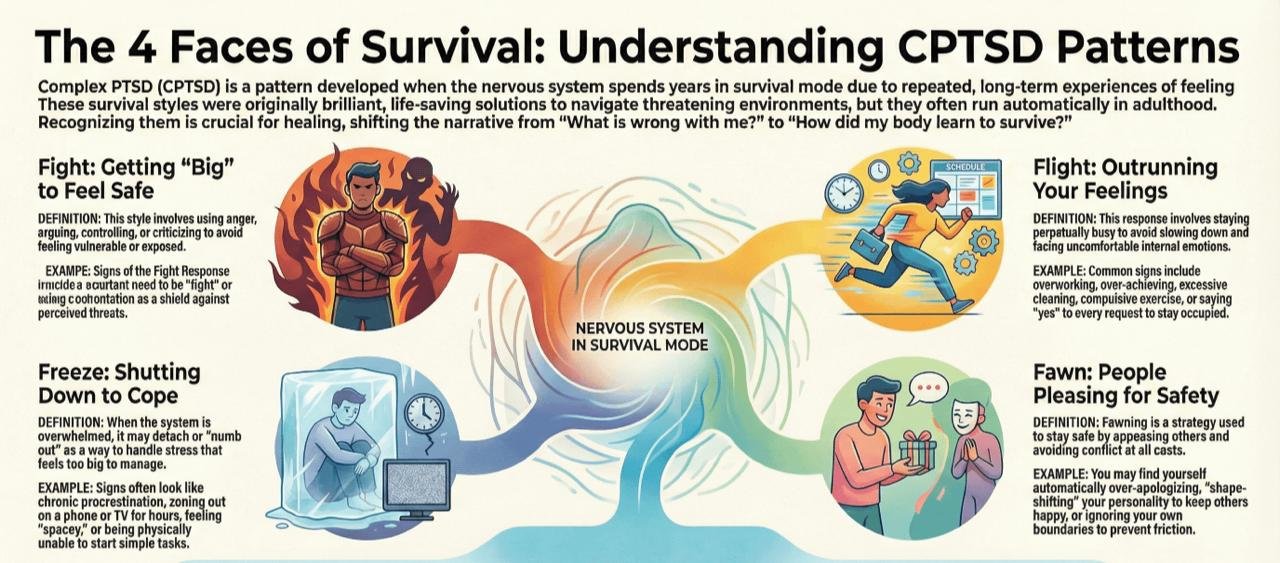
When you grow up in chronic stress, you find ways to cope. Those coping strategies are smart and often lifesaving in the original environment. The challenge is that they tend to keep running, even when you are in a different situation.
Many people with Complex PTSD recognize themselves in one or more of these survival styles:
These patterns often started as brilliant solutions in a scary or unpredictable environment. The problem is that, in adult life, they can make it hard to feel close to others, to know what you truly want, or to set boundaries that protect you.
It can be surprisingly healing just to recognize, “Oh, that is my old survival style showing up,” instead of criticizing yourself as being lazy, dramatic, or impossible.
What Complex PTSD is not?
Because the term trauma is everywhere now, it is easy to feel confused or even invalidated. It may help to know what Complex PTSD is not.
It is not a sign that you are weak or making things up, have a personality flaw or are making too much of what you went through. In our Charlotte office, we frequently hear clients say that “I shouldn’t be feeling the way I do, others have had it so much worse than I have.” We call this the “green bean theory,” as in “eat your green beans because not everyone has enough to eat.” One doesn’t have any bearing on the other. What is true is that you are entitled to your own feelings, responses and history. The fact that others have had harsh experiences growing up doesn’t diminish what you experienced.
Complex PTSD is also different from:
- Standard PTSD, which is often linked to a single, identifiable event, with more classic flashbacks and nightmares
- Just anxiety or depression, even though those are extremely common alongside C PTSD
- Simply being sensitive or emotional
Getting a clear picture of what is happening is not about slapping a label on you. It is about making sense of your experiences so you can find tools and support that actually fit.
Healing in real life, Including right here in Charlotte
Healing from Complex PTSD does not mean erasing the past. It means slowly teaching your nervous system that it does not have to live in emergency mode all the time, and building a different relationship with yourself.
Healing often begins with safe connection. Having at least one person, often a therapist, who listens, believes you, and responds without judgment can make a meaningful difference. From there, many people find it helpful to learn to notice emotional flashbacks and survival styles as they arise, approaching them with curiosity rather than automatic self-criticism. Alongside that, practices that work directly with the body, such as gentle movement, deep breathing, yoga, or grounding exercises, can help your nervous system begin to feel more settled. Over time, the inner critic that developed to help you survive can gradually soften into something more like a caring, realistic inner voice.
People experiencing long-term trauma often look for support from a complex PTSD therapist in Charlotte provides, as well as other trauma-focused programs. Some use approaches like EMDR, somatic therapies that focus on the body, or parts based work that helps you relate more kindly to the different younger parts of yourself that hold pain. Others combine talk therapy with skills for calming your nervous system and building healthier relationships.
If you are not ready for complex ptsd therapy, even starting with small steps, like reading about trauma, practicing one grounding skill, or talking to a trusted friend, can begin to shift things. Healing does not have to be dramatic to be real.
From just surviving to actually living
If survival mode has been your default for years, the idea of living any other way might feel foreign or even unsafe. Change is rarely quick, and it often comes with setbacks. That does not mean you are failing. It means your nervous system is learning something entirely new.
Over time, many people begin to notice more moments of calm between the difficult ones, and a bit more space to pause before reacting. Saying no starts to feel possible sometimes, without as much fear or guilt attached to it. And gradually, the way a person sees themselves begins to soften.
Your survival strategies were never proof that something was wrong with you. They were proof that you did whatever it took to get through what you had to get through. Now, if you choose, you can start learning a new pattern, one that is not only about surviving, but about having room for rest, connection, joy, and a sense of being at home in your own skin.
You were never meant to live your entire life in emergency mode. Even if you have been there for a long time, it is still possible to move, step by step, toward a life that feels more like living and less like constant survival.
At Montgomery Counseling Group, we understand that living in survival mode for years can make it difficult to imagine something different. Our therapists in Charlotte, NC provide trauma-informed counseling for individuals working through complex trauma and its lasting effects.
If you’re considering support, you’re welcome to reach out to learn more or schedule a consultation.