
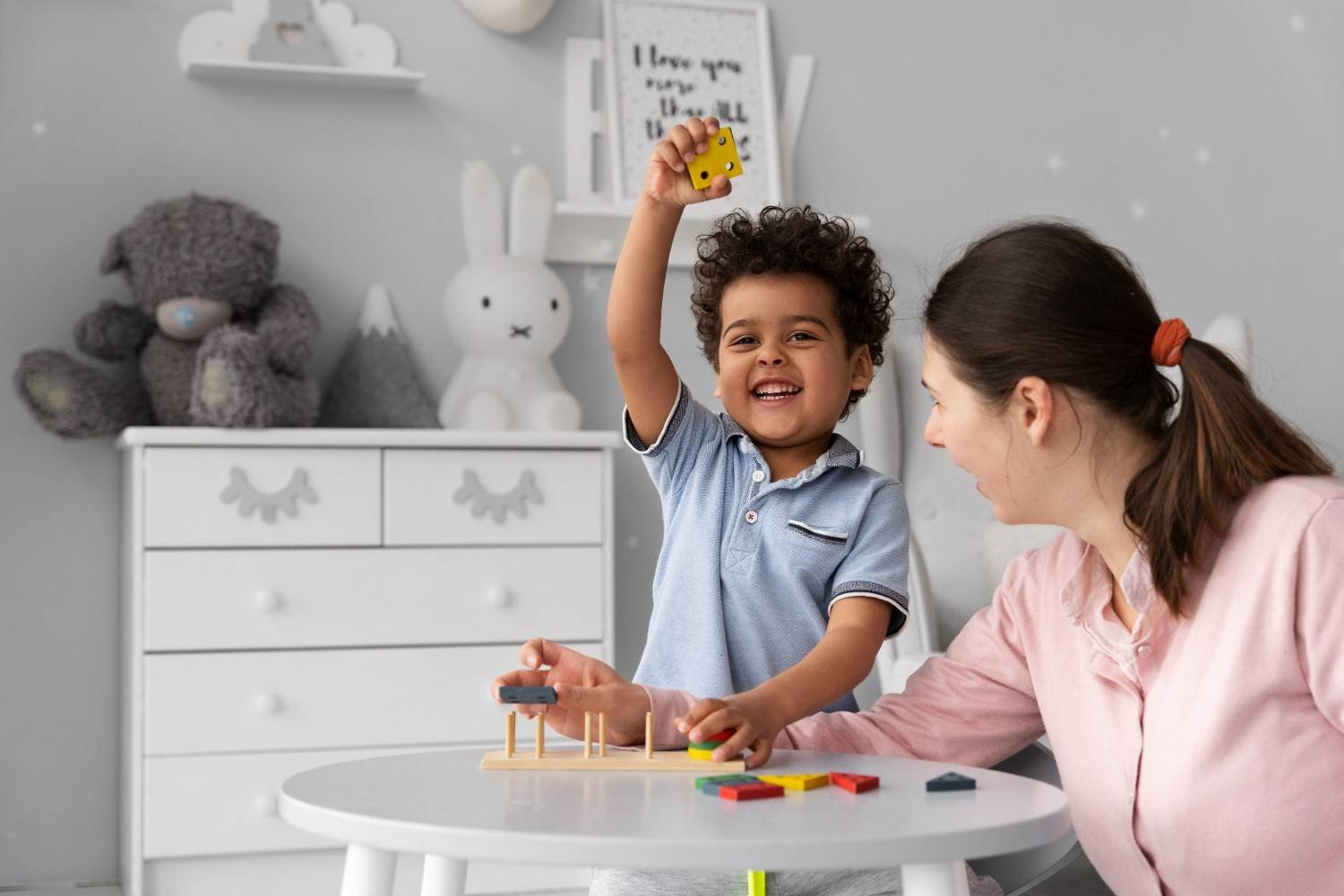
Something has shifted. Maybe your child has been harder to reach lately: quicker to shut down, slower to bounce back, more on edge than they used to be. Or maybe something specific happened and you can see that they’re still carrying it, even if they can’t say so. You’ve tried asking. They say they’re fine, or they say they don’t know, or they don’t say anything at all. That’s not stubbornness. And it’s not a sign that something is wrong with how you’re communicating. For most children, and for many adolescents, the path to what they’re carrying doesn’t go through words. It goes through what they do with their hands, what they build, what they draw, what games they ask to play. Play therapy in Charlotte works with that.
Why Talking Isn’t Always the Way In
Adults generally understand therapy as a talking process. You sit across from someone, you describe what’s been happening, and together you work toward something different. That process depends on a fairly developed capacity for self-reflection and on the ability to translate inner experience into language. The American Psychological Association’s resources on child development and mental health explain why children’s processing needs look fundamentally different from adult needs — and why approaches like play therapy for children are clinically grounded in how kids actually develop.
Children are still building both. A child who is struggling with something frightening or confusing doesn’t necessarily know how to name it, and may not even know that’s what’s happening. What they do know is what the dollhouse family needs to do this week, or why the clay monster has to be very large, or why they keep wanting to play the same game where everything works out at the end. To an adult watching, this might look like ordinary play. To a trained play therapist, it’s information.
Play therapy is built on the understanding that play is the primary language of childhood. A child who can’t yet say “I’m scared about what’s changing at home” can often show it. The therapist’s job is to understand what’s being shown.
What a Play Therapy Session Looks Like
The play therapy room isn’t set up like a standard office. It’s stocked with materials selected for what they make possible: art supplies, a sand tray with small figures, puppets, books, and construction materials. These aren’t there to keep children busy. They create possibilities for a child to express what’s happening internally before they have the words for it.
It Isn’t Unstructured Play
A common misconception is that play therapy means giving a child free time and watching what they do. It’s more precise than that. The therapist brings clinical training to every session, tracking what a child gravitates toward and what they avoid, noticing recurring themes, observing how conflicts get resolved in play and where they get stuck. Some sessions are more child-led. Others involve the therapist introducing a specific activity or scenario. The balance depends on what that particular child needs at that particular point in the work.
What the Therapist Is Watching
When a child plays in the therapy room, the therapist is paying attention to more than the content of the play. They’re observing what the play reveals about how the child understands their world: who has power, who is safe, what can be fixed and what can’t. They’re watching the child’s body: where tension shows up, when something lands hard, when a child relaxes without realizing it. Over time, patterns emerge. Those patterns tell a story. And within that story, there’s information about what the child is carrying and how they’re making sense of it.
What Age Range Does Play Therapy Work For?
Play therapy in Charlotte isn’t only for young children. At MCG, the approach is used with children and adolescents from age 3 through 18, with the specific tools and methods adapted for each developmental stage.
For younger children, sessions may look closest to what most people picture: hands-on, expressive, often nonverbal. For older children and adolescents, the modality shifts significantly. Sand tray work, art-based techniques, and narrative approaches tend to be more relevant than toys. The underlying principle stays the same: meet the young person in the mode of expression that fits them. The materials and the therapist’s approach change as development does, but that orientation doesn’t.
Adolescents sometimes assume therapy for kids Charlotte NC means being required to talk through their feelings directly. For many teens, knowing that’s not the only option makes the idea of coming in feel more possible.
What Play Therapy in Charlotte Can Help With
Play therapy in Charlotte is used with children and adolescents across a range of experiences. The National Institute of Mental Health’s resources on child and adolescent mental health underscore why early support during formative years can have lasting impact. These include:
- Big life transitions: a new school, a move, a shift in family structure
- Grief and loss, including the death of someone important, the end of a relationship, or the loss of a sense of safety or stability
- Anxiety that shows up in behavior rather than in words. Understanding how anxiety in children manifests — often through behavior rather than expressed worry — can help parents recognize when play therapy for children might be the right support.
- School avoidance or persistent difficulty in the school environment
- Changes in behavior following something hard
- Parent-child relationship challenges, including communication that has become stuck
- Experiences that are difficult to put into language
For children and adolescents with ADHD, play therapy can be a particularly good fit. ADHD affects how a young person regulates attention, energy, and impulse, and those patterns can make a conversation-based format difficult to access. Play therapy in Charlotte doesn’t require stillness or sustained verbal focus. It works with the way a child with ADHD is already oriented to the world, which can make the therapeutic space more accessible and the work more sustainable.
This isn’t an exhaustive list, and the experiences above don’t need to be severe or clearly defined. The place to start is always with what you’re noticing. Not with a label for it.
Learn More About the TeamVisit our therapy for children and adolescents page to learn more about what play therapy Charlotte NC looks like at MCG. |
What Parents and Caregivers Can Expect
Play therapy in Charlotte isn’t something that happens to a child in a separate room while you wait. Michelle Daley, your child therapist Charlotte NC at MCG, works closely with parents throughout the therapeutic process. You’ll have a real picture of what the work is focused on, even if the specific content of individual sessions stays between the therapist and your child.
Your involvement matters. What gets worked on in the therapy room is more likely to carry into daily life when the people at home understand what’s happening and can support it. That doesn’t mean you need to become a therapist for your child at home. It means you stay in the process.
For some families, that includes sessions where a parent participates directly, particularly when the focus is the parent-child relationship, communication, or how the family is working through something hard together.
Starting the Process
If you’re reading this because you’ve noticed something and you’re trying to figure out what to do next, that instinct is a reasonable place to start. You don’t need a clear problem statement. You don’t need a specific event that explains what’s happening. You just need to have noticed that your child is carrying something and that they could use support. Montgomery Counseling Group works with children and adolescents ages 3 through 18 in Charlotte, NC. Telehealth services are available for families throughout North Carolina. Review our Rates & Insurance page before reaching out, then contact us to schedule a consultation.
Schedule a ConsultationBook your child’s first session — play therapy for children and teens in Charlotte NC and via telehealth across North Carolina. |
This content is for educational purposes only and does not constitute clinical advice. If you are experiencing distress or mental health concerns, please consult a licensed mental health professional.
Frequently Asked Questions About Play Therapy
What is play therapy, exactly?
Play therapy is a clinical approach that works with the way children and many adolescents naturally process their experience: through activity, expression, and creative engagement rather than verbal reflection alone. The therapist uses materials like art supplies, sand trays, puppets, and construction tools to create space for a child to show what they’re carrying before they can say it. A play therapist brings clinical training to what they observe in those sessions, tracking patterns and themes over time.
Is play therapy only for young children?
No. Play therapy is used with children and adolescents from age 3 through 18. The approach adapts significantly by developmental stage. For older children and teens, sand tray work, art-based techniques, and narrative approaches are often more relevant than traditional toys. The underlying principle stays the same across ages: meeting the young person in the mode of expression that fits them.
Does my child need a formal diagnosis to start play therapy?
No. A formal diagnosis is not required to begin. Many families come to MCG because they’ve noticed something has shifted for their child and they want support. The intake process is designed to understand what’s happening for your child and your family, and to determine whether play therapy is the right fit.
Will I know what happens in my child’s sessions?
Yes, in the ways that matter. Michelle works closely with parents throughout the process. You’ll have a clear picture of what the therapeutic work is focused on. The specific content of individual sessions stays confidential between the therapist and your child, which is part of what makes the space safe enough to be useful. Parent involvement is built into the process, not added on at the end.
What is a sand tray and how is it used?
A sand tray is a shallow box of sand accompanied by a wide range of small figures: people, animals, buildings, natural objects, and symbolic items. A child or adolescent arranges the figures in the sand, creating a scene. The therapist observes the scene and the process of building it, paying attention to the choices made, the relationships between figures, and the themes that emerge. Sand tray work is particularly useful for young people who are not yet ready to address an experience directly.
Does MCG offer play therapy in Charlotte, NC?
Yes. MCG offers play therapy for children and adolescents ages 3 through 18 at its Charlotte, NC office. Telehealth services are available for families throughout North Carolina. To learn more or schedule a consultation, visit the children and adolescents page.
Continue Reading
You may also find these helpful:
- Your Child Isn’t “Acting Out”: They’re Asking for Help. Here’s How Play Therapy Responds
- How Play Therapy Helps Children Process Trauma and Build Resilience
- EMDR Therapy for Children and Teens in Charlotte, NC
- How Children Process Trauma Without Words
- What to Do When You Know Help Would Be Good But Can’t Make Yourself Go